
The Future of Search: What is GEO?
Author: Scott Lee
Date: November 13
Read time: 4 min
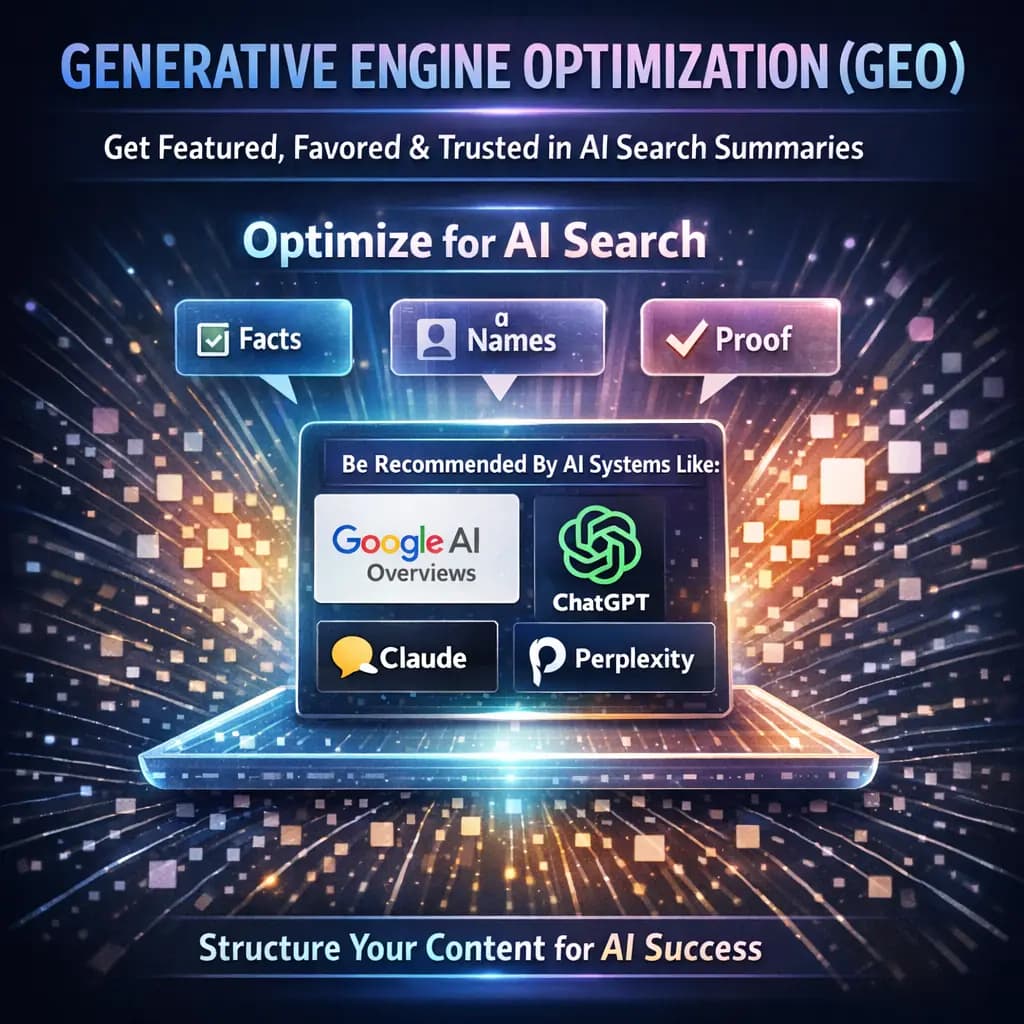
Generative Engine Optimization (GEO) is how brands get featured, favored, and trusted in AI search summaries. Instead of optimizing for blue links, GEO structures your facts, names, and proof so systems like Google's AI Overviews, ChatGPT, Claude, and Perplexity can confidently recommend you.
SEO puts you on a list, GEO puts you on top.
At its core, GEO is about earning trust from machines that speak to humans. Search is shifting from "where can I find it?" to "who should I trust?" and generative engines are the new gatekeepers of that trust. These systems don't rank a list; they write an answer. That means they need sources that are factual, consistent, and easy to verify. GEO makes your company one of those sources.
GEO also creates measurable visibility. You can track how often your brand appears in AI-generated answers, how positively you're described, and how many of those mentions turn into site visits, leads, or meetings. It closes the loop between your visibility in AI and your actual business outcomes, creating a new path for qualified demand.
Think of it as the evolution of SEO for the AI era. SEO is ingrained in GEO, so it is not "dead".....yet, but the decline is intensifying to a GEO-centered era of search.
Why Your Google Results Look Different in 2025
Search for a "how-to", a "which is best," or a legal/medical explainer, and you'll often see an AI Overview (AIO), also known as an AI Summary; a synthesized answer above the links. Helpful for humans, tougher on click-through.
Here are some facts which put the rise of AI search results in perspective:
- 58% of Google searches now result in zero clicks.
- AIOs show for almost 55% of Google Searches (and this number is expected to rise rapidly to close the gap.)
- U.S. desktop coverage shows 30% of U.S. desktop keywords triggered AIOs in Sept 2025, with mobile frequency up ~475% year over year.
- Some sites have seen a 20-40% decrease in search traffic since the introduction of AI Overviews.
- When AI does send traffic, it can convert double what organic search converts. Similarweb finds AI-referred visits convert ~11.4% vs. 9.3% paid search and 5.3% organic (June 2025 cohort; published Sept 17, 2025).
Bottom line: The answer box is the new shortlist. If you're not present or not cited, you're effectively invisible.
FAV - The Outcomes of GEO
GEO is the discipline of positioning your business, so AI tools naturally recommend it to users. Practically, it focuses on three outcomes:
- Favorability — the model can defend why you're the pick (clear differentiators, proof).
- Accuracy — your site and consistent third-party profiles are the primary sources it cites, ensuring you control your own narrative.
- Visibility — you appear when buyers ask, "Who are the top vendors for X?"
GEO connects to a proof layer that enables stakeholders to highlight a direct path from AI visibility to opportunities to conversion revenue, moving beyond vanity metrics.
How to Use FAV Day to Day
- Nudge how you're described toward a clear "best for ___" story (Favorability).
- Make sure the facts match your site and profiles (Accuracy).
- Check weekly if you show up for key questions buyers ask (Visibility).
When those three move together, you'll see more qualified inquiries and deals, not just traffic. FAV keeps the focus on outcomes: show up, be right, be chosen.
GEO vs. SEO (Same Family, Different Job)
If you speak SEO, these translations will feel familiar:
SEO helps people find you. GEO helps AI choose you.
The Benefits of GEO
Show Up Where Decisions Get Made
GEO helps you show up where decisions now get made: inside the answer. When the summary appears, a shortlist forms before anyone scrolls. If your brand is named and cited there, you've earned visibility that traditional rankings can't guarantee because you're present at the exact moment of intent.
Create Competitive Advantage
It also creates a tangible, competitive advantage. Generative engines reward clarity, consistency, and proof. When your claims are concise, supported, and verified by third parties, the model can confidently vouch for you, repeating your differentiators instead of your competitor's. That's how category stories take shape: the version in the answer becomes the version in the buyer's mind.
Make Your Content Work Harder
GEO makes your content work harder. A single, well-structured explanation can feed multiple platforms like Google's AI Overviews, chat answers, and voice assistants without endless rewrites. You update your facts once and every surface that references you. This shifts your strategy from chasing clicks to earning mentions where attention actually lives.
Future-Focused Investment
It's also a future-focused investment. As zero-click behavior grows and AI assistants handle more of the research process, visibility moves into the generated response. GEO meets that change head-on by treating your content as a trusted source, not just a marketing piece. Clear facts, stable naming, matching schema, and consistent corroboration make your information durable across systems and formats.
Measurable Impact
Finally, GEO delivers measurable impact. You can track how often you appear in AI answers, how your brand is described, and how many citations lead to actual opportunities in your CRM. It turns visibility into something tangible: proof that your expertise is being recognized, recommended, and driving real business outcomes.
SEO still matters for getting on the map. GEO makes sure you're the source recommended once people arrive.
What "Doing GEO" Looks Like
Answer the Big Questions Once, Clearly
Publish a Canonical Answers page for your category (this article can be your /geo).
Lead with Facts
Put key data in simple tables and definition lists so machines can quote you cleanly.
Name Things the Same Way Everywhere
Consistency is key: Company, product, and feature names should match across your site and authoritative profiles.
Echo Your Facts Off-Site
Place the same numbers in analyst/trade outlets so models see corroboration, not just self-claims.
Prove Business Impact
Track Appear Rate / Favorability / Citations in AI answers and map those sessions and meetings to your CRM.
Partner with Specialists
GEO requires technical expertise in structured data. A specialized GEO agency brings the tools, methodology, and proven frameworks to implement these strategies effectively.
"AI is your new five-star review."
GEO earns that review and makes sure it points to you.
In Summary, The Rise of GEO is Here…
GEO isn't "AI-powered SEO." It's the recommendation layer of modern discovery: make your message easy to trust, easy to share, and easy to act on.
As AI reshapes search, GEO ensures your brand becomes the trusted, cited source in generated answers. Turn AI into your competitive advantage, not a threat.
Tags: Generative Engine Optimization, SEO versus GEO, What is GEO, GEO, SEO